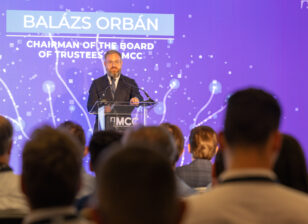

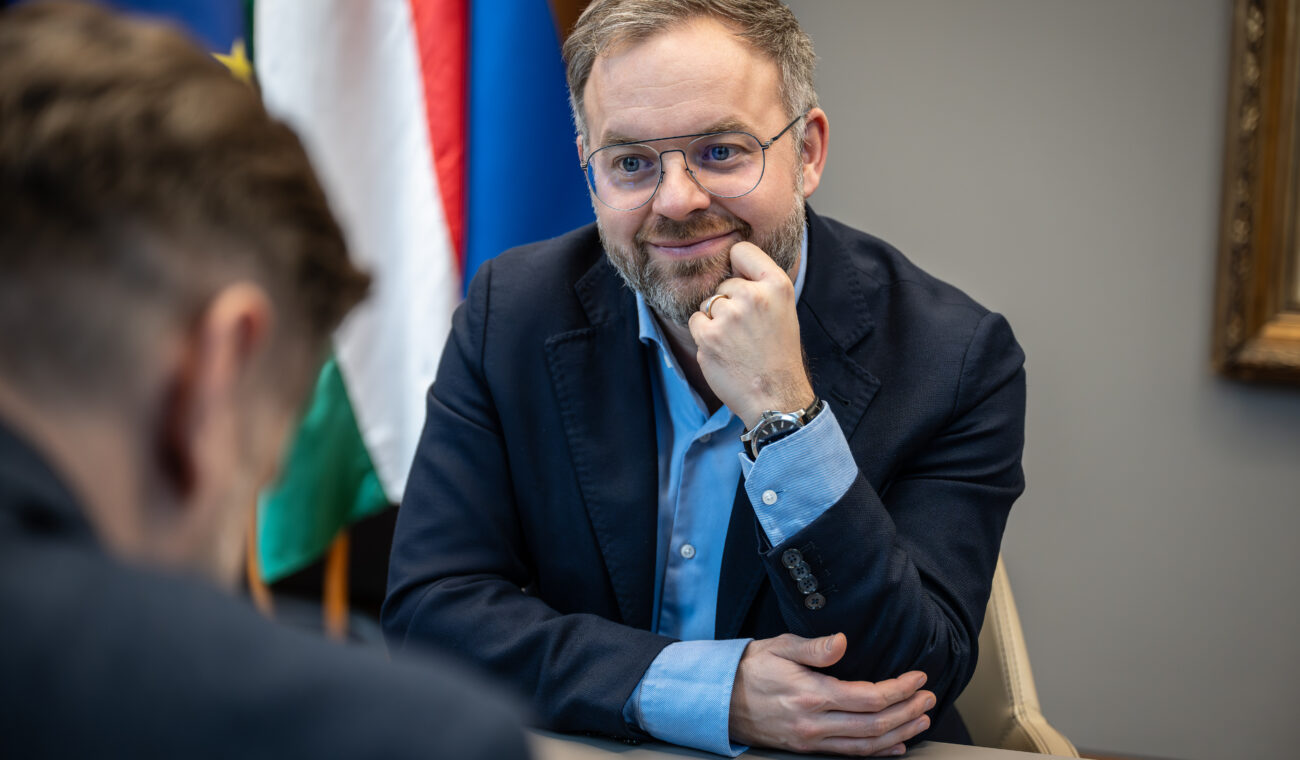
Index interview // Balázs Orbán: In an uncertain world we are the safe choice
Balázs Orbán: In an uncertain world we are the safe choice
According to the Prime Minister’s political director and Fidesz’s national campaign manager, the era when people voted every four years without any fundamental changes in their lives has come to an end. “Today, the most serious civilizational issues are causing tension throughout the Western world on a daily basis, and these cannot be resolved with meaningless political messages”, said Balázs Orbán to Index. He went on to call Tisza Party an “uncertain, vague experiment supported by Brussels and Kiev”, while adding that this is not the time to do experiments. In the upcoming weeks they would like to meet every single voter personally and would not consider it unrealistic to repeat the 2022 results.
In his interview with Index, the political director stated:
• There is a realistic chance that we will drift into the war, while Brussels is asking us if we are willing to spend hundreds of billions of Forints to support Ukraine. Pro-war governments across Europe are introducing tax increases and austerity measures. Our campaign focuses on ensuring that Hungary does not follow Brussels’ lead.
• Péter Magyar is a cunning character, he always has been, and now he is being pulled around by strings from abroad. It does not matter what he says, the real question is what is expected of him.
• Even some opposition analysts acknowledge that Fidesz is dynamic, that Viktor Orbán’s personal involvement is helping the campaign, that it boosts the confidence of our activists, and that Fidesz has a realistic, clear chance of winning the election.
• As the odds of Plan A seem to vanish, Plan B from Brussels is unfolding in an increasingly spectacular fashion. There will be no prime minister from Brussels, but they want to keep Viktor Orbán’s next national government under pressure from the very beginning. This explains why, while they were previously talking about a two-thirds victory, the new narrative today is one of an election fraud.
• In 2025, we saw for the first time that rivalling superpowers and middle powers were equally interested in Hungary’s success.
• Today, every single election in Europe is about security: war, migration, economic prospects, and whether the next generation will be better or worse off. […] Here in Hungary, our opponents would prefer the campaign to be about selfies and domain name registrations, while they remain silent or make misleading statements about the real issues that are crucial to our civilization. They themselves have admitted that if voters knew exactly what they were planning, they would fail.
• Until now, we have been criticized for becoming isolated within the West. Against this backdrop, it is difficult to fault us for forming a strategic partnership with the most powerful nation in the Western world.
Did everything go to plan on the day of Fidesz’s campaign launch congress?
We had a fantastic event. Two thousand five hundred people attended, including delegates and leading politicians. The event dominated public discourse for several days. Even at an international level, several figures expressed strong support for Fidesz–KDNP. We have our candidates, we are strong, united, and confident. We have articulated a clear, positive message for Hungary, and it is absolutely clear what mandate we are asking for. I consider this a major success.
Was there no shouting in your campaign team because Péter Magyar registered a domain with Fidesz’s new slogan?
Domain registration is not common practice for us because we have a website, fidesz.hu, which has been operating for decades. Veteran campaign experts have taught me that you should never prevent your opponent from making mistakes. The fact that the country talked about our campaign event, the congress, and Fidesz’s message for days — that is, that we are the safe choice in an uncertain world — is, in my opinion, a gift from our opponents.
So, you had no plans to secure the domain and create a website with your own messages for campaign purposes?
Why would we have done such a thing?
Are you not bothered at all that Péter Magyar has created a website critical of the government with your campaign slogan?
Go for it, good luck! We are not interested in securing domains; we want to win the election.
They even filed a trademark application.
Well, that is legal nonsense. It made a lot of lawyers laugh out loud; there is no such thing.
What do you think about Péter Magyar campaigning by making you “look ridiculous”? Indeed, the president of the Tisza Party has personally targeted you and claims that your position as campaign manager is in jeopardy.
We are not concerned with our opponents’ campaign because they are not interested in the good of this country, they are only interested in power. We are concerned with convincing the nation that we are in an extremely dangerous situation. There is a realistic chance that we will drift into the war, while Brussels is asking us if we are willing to spend hundreds of billions of Forints to support Ukraine. Pro-war governments across Europe are introducing tax increases and austerity measures. Our campaign focuses on ensuring that Hungary does not follow Brussels’ lead. We are open and straightforward: we say what we want and what we are asking for authorization to do. Our opponents pursue a policy of pretense and flattery: one moment they say one thing, then the next they say something else. I think this is clear to everyone now, and most people dislike it. The Tisza Party is an uncertain, vague experiment supported by Brussels and Kiev, but now is not the time for experimentation.
Péter Magyar claims that the pro-government slogan was leaked to them by Fidesz’s campaign team. Are you already looking for the mole in your campaign team?
He is lying even when he is asking questions. We announced the slogan publicly in the morning.
How do you get on with Antal Rogán?
This is a team where everyone wants to win, and in order to do so, we all work well together.
I am asking this because, according to Péter Magyar, your party wants to bring Antal Rogán back as campaign manager.
I do not want to upset him, but he is already part of the campaign team. By the time this interview is published, there will be new lies, and his statements are completely irrelevant. This sums up his entire operation. He said he would not take up his seat in the European Parliament, but then he did. He said he supported the abolition of parliamentary immunity, but then he backed down. He claimed that they did not support Ukraine’s EU accession, but then he had his own supporters vote on it, and it turned out that they did support it after all. He later denied this, against the decision of his own voters, while his party votes for everything that is expected of them in Brussels. Péter Magyar is a cunning character, he always has been, and now he is being pulled around by strings from abroad. It does not matter what he says, the real question is what is expected of him. We need to speak to the majority of Hungarian society: to those who recognize the threats, the risk of war, the consequences of Ukraine joining the EU, and also that if Hungary had a Brussels-controlled government, opportunities would not increase but decrease. We need to convince them that Fidesz is the safe choice.
“Every decision made by the Tisza Party can be understood through the lens of Brussels”
There are two conflicting interpretations of your role as campaign manager: some claim that you were assigned this task because of your connections with American campaign consultants, while others believe that your appointment is mere formality and that it is actually Viktor Orbán who is running the campaign. Who is in charge of the campaign, you or Viktor Orbán?
For a governing party, everyday life during a term in office is completely different from that of an opposition party. The most important thing for us is proper government, which is what I have been contributing to, but as the elections approach, more attention may be paid to seeking a new mandate. Until last summer, the general sentiment was that Fidesz was vulnerable, unable to offer any new ideas and unable to stand up for the Hungarian people with sufficient force. In response to this, we set up a new campaign management system, as a result of which we are now confidently leading in opinion polls that are not designed to make our opponents look better. Even some opposition analysts acknowledge that Fidesz is dynamic, that Viktor Orbán’s personal involvement is helping the campaign, that it boosts the confidence of our activists, and that Fidesz has a realistic, clear chance of winning the election.
How much do American campaign advisors get involved in shaping the campaign?
We work with a Hungarian campaign team, not foreigners.
The American campaign logic is clearly visible in the appearance and choreography of your events so far…
This campaign has featured a host of innovative solutions. The anti-war rallies, the digital civic circles, and the involvement of civilians are all new elements that the Hungarian right wing has not utilized in their previous campaigns.
These events are not just about politicians, but also show that there is widespread support for the anti-war stance of Fidesz–KDNP among a broad section of society: public figures, artists, musicians, actors, and local intellectuals.
This is not a question of campaign technology, and it is not something that needs to be learned from foreign campaign advisors. The world around us has changed. People used to vote every four years without any fundamental changes in their daily lives. Today, the most serious civilizational issues are causing tension throughout the Western world on a daily basis, and these cannot be resolved with meaningless political messages. We saw this in the United States with Donald Trump’s comeback: he was backed by an entire social movement. In the end, of course, people vote for politicians, but in reality they side with a movement that represents a way of life, a set of values. We see the same thing today across Europe with the rise of patriotic forces. We do the same in Hungary: we are organizing a social movement. One that says no to war, no to spending Hungary’s money on Ukraine, no to migration and no to the civilizational dead ends into which Brussels wants to lead the continent. The essence of my work as campaign manager is to see whether we are capable of building a resilient Hungarian social movement. Once we have that, political success will follow: on April 12, we might achieve not only a social majority, but also a political majority.
What was the decision-making process behind the campaign slogan “Fidesz is the safe choice”? Who came up with the idea?
The slogan is rooted in Fidesz’s identity. In times of crisis and uncertainty, people do not ask who is the most effective in sweet-talking them, but who they can rely on. That is the question we are putting at the center of the election. Fidesz can point to a thirty-five-year history: anti-communist roots, national, patriotic, and constitutional traditions, anti-migration policies, and a stance against the imperial ambitions of Brussels, as well as an anti-war stance. Work for everyone, lower taxes, higher wages, more opportunities. We have been at the helm for sixteen years, and everyone knows what to expect from us. In the other corner, however, there is the showpiece politics openly supported by Brussels and Kiev, backed mainly by left-liberal public policy principles. In an uncertain world, that is not very encouraging. This assessment of the situation leads to the message that “Fidesz is the safe choice.”
After more than fifteen years in government, if you have to emphasize that “Fidesz is the safe choice,” it can also be interpreted as an admission that you are no longer the safe choice for a significant portion of Hungarian voters. This essentially feels like an admission that the situation has changed since previous years and that a formidable opponent has emerged.
The left-wing, Brussels-backed alliance led by Péter Márki-Zay secured 34.5 percent of the votes in 2022. They used the same campaign tools then as Péter Magyar is using now, and very similar elements are appearing at this stage of the campaign.
There is a segment of the population who believe that anything is better than Fidesz. However, the majority of opposition voters rightfully ask themselves whether this is really the case. Change is not an opportunity, but a threat.
In fact, they are also benefiting from Fidesz’s leadership, because their lives are safer and more predictable.
They also receive a 14th month pension, they are eligible for family tax relief, they are not being conscripted or having their grandchildren conscripted, and their loved ones are not being sent to fight to Ukraine. No one else can guarantee this because they do not have enough power to do so. We therefore appeal to the common sense found in every human being and assume that no one will vote against their own interests. Our experience and recognition constitute our advantage and, at the same time, our greatest strength.
Public opinion polls show varying results: some surveys indicate that the Tisza Party has a significant lead. What is clear from all polls, however, is that Fidesz–KDNP will at least face a strong opponent in April. There is a solid voter base that is particularly keen to see Viktor Orbán removed from office and which has not been convinced that Fidesz is the safe choice. Does this not indicate that something has been done wrong?
In every election, we strive to convince as many people as possible. Last time we achieved one of the greatest victories in Hungary’s history, and we have been leading the polls ever since, and we are also the favorites to win the next election. When it comes to opinion polls, it is worth remembering that before 2022 certain institutes were off by 20 percentage points. Let’s not be naive, this was no accident. If they “get it wrong” again now, we should be good.
But how can we accept any of them as accurate if one opinion poll can be affiliated with one side and the other with the other side?
Every decision made by the Tisza Party can be understood through the lens of Brussels. Their number one plan is to have a Brussels-backed prime minister for the country. First, they tried to create a situation in which they could give the false impression that Tisza will definitely win. People don’t believe this; according to all polls, the majority expects us to win. As the odds of Plan A seem to vanish, Plan B from Brussels is unfolding in an increasingly spectacular fashion. There will be no prime minister from Brussels, but they want to keep Viktor Orbán’s next national government under pressure from the very beginning. This explains why, while they were previously talking about a two-thirds victory, the new narrative today is one of an election fraud. They are already factoring in defeat, and Péter Magyar, under a pseudonym, has already written the narrative on social media. Researchers will then say with innocent eyes that they don’t understand how this could have happened. The same thing happened with Trump’s election. In contrast, there is only one possible defense: you have to win by a large margin.
“Hungary has two paths ahead of it”
In his forty-five-minute speech at the party congress, Viktor Orbán assessed global political developments and delivered an indictment of his opponents, but he did not address the everyday problems and livelihood issues facing Hungarians. If Fidesz is the safe choice, why did the prime minister not talk about these issues?
We may not have heard the same speech. People are entitled to ask what politicians have to say about day-to-day problems in these difficult and uncertain times. They want to know how taxes can be lowered, how subsidies for businesses can be increased, how young people can buy homes, which in many places in Western Europe they can no longer afford, and how pensioners can receive higher benefits to help them pay for increased food prices. The Prime Minister has made it clear that Hungary has two paths ahead of it. The Brussels path means less money and fewer opportunities.
It is enough to listen to what they say: they want more money for the war, for Ukraine and for the implementation of the migration pact. This rightly raises the question: where are the Europeans in this, where are the Hungarians, and how does this help people make a living?
They have no answer to this because it is not important to them. The Hungarian government, by contrast, argues that we must help people with issues that are important to them. The government has delivered on its promises for this term. It has guaranteed jobs, wages, pensions, family support, and that Hungary will stay out of the war. We have no austerity measures or tax increases, the minimum wage has increased by 11 percent, inflation-adjusted wages have risen, we have restored the 14th month pension, expanded family benefits, launched an energy storage program, and introduced a housing subsidy program for public service employees. This was what the Prime Minister’s speech was about, and it affects the daily lives of all Hungarians, which is why I consider it effective.
When I mentioned everyday problems and the issue of livelihood security, I was referring to inflation, people complaining about rising food prices, hospital waiting lists, and the state of healthcare facilities.
That is exactly what I am talking about. If the war continues or escalates, and we choose the path of Brussels and continue along their war logic, prices will also rise. Where there is war, energy costs increase, food prices increase, and it becomes more difficult to make a living. There is a clear correlation. There are also proposals from Brussels regarding healthcare, the essence of which is that there are too many hospitals, spending should be reduced, and private insurance should be brought back. In the long term, this would lead to a pay-as-you-go system and reduced access. There would be fewer hospitals and healthcare facilities, while they claim that the remaining institutions would provide higher quality care. The same promise was made in the past by Gyurcsány, the SZDSZ and the Bajnai administration, but experience has shown that the system has not improved, it has in fact worsened. We either spend more on Ukraine or on Hungary. There is no middle ground. Today, two programs are pitted against each other: we are open about ours, while the other side is keeping their real plans a secret, even though Brussels has already laid out the direction. Could a program that claims “we have to win the election, and then anything is possible” really bring better healthcare, better education, and lower prices? I seriously doubt it. In my opinion, we can only achieve this if we stay on the Hungarian way and do not turn towards Brussels.
The entire campaign launching congress seemed to be about how anyone who does not vote for Fidesz is voting for war, migration, genderism, “Brussels’ puppet,” and if the government does not win, an apocalypse will ensue. Is fearmongering and society’s desire for security and stability the ultimate weapon of the governing party?
Today, every single election in Europe is about security: war, migration, economic prospects, and whether the next generation will be better or worse off. These are fundamental political issues throughout Europe today. Here in Hungary, our opponents would prefer the campaign to be about selfies and domain name registrations, while they remain silent or make misleading statements about the real issues that are crucial to our civilization. They themselves have admitted that if voters knew exactly what they were planning, they would fail. In contrast, we speak openly about who we are, what threats we see, and what we are asking for a mandate to do.
None of the opposition parties are claiming that they want war. As for the Tisza Party – or at least Péter Magyar – they have so far expressed a position on migration that is similar to that of the government on several points.
It is not me you should believe, but the facts. The President of the European Commission has spoken publicly about military confrontation with Russia, Ukraine’s accelerated accession to the EU, war economy logic, and increased support for Ukraine. These are well-documented statements. These policies are also advocated by the leadership of the European People’s Party, of which Péter Magyar is a member, and which openly considers support for Ukraine a condition for cooperation. Accordingly, they also voted in favor of cutting ties with Russian energy sources and financing the war in Ukraine. Official voting documents are available on this matter. The same is true of the migration issue: despite Hungary’s resistance, the European People’s Party accepted the new migration pact, which brings back quotas, mandatory resettlement, and open admission centers. Ursula von der Leyen recently stated that the pact had to be implemented.
Motions of no confidence against the Commission President are unsuccessful because Tisza and DK vote in favor of Ursula von der Leyen. These are facts.
If anyone considers Péter Magyar’s latest social media posts, which change from hour to hour, to be indisputable truths, then they should treat the statements of their own Tisza politicians and experts, as well as the speeches in the European Parliament and the official decisions supported by the Tisza political community, with at least the same weight. These are not occasional campaign messages, but recorded political statements. The question is rather why he does not talk about them. It is because he wants these connections to remain hidden.
Just to be clear: Péter Magyar has repeatedly stated that he does not support Ukraine’s accelerated accession, and he has promised that if the Tisza Party wins the election and the issue becomes relevant, a decisive referendum will be held on Ukraine’s EU membership.
But didn’t he say earlier that he would not be a member of the European Parliament? Of course, he did. Did it matter? No, it didn’t. It is an ominous sign that the Ukrainian press and Ukrainian government statements regularly claim that one of the obstacles to Ukraine’s accession to the EU is the current Hungarian government and that these obstacles would be removed in the event of an opposition victory. These are official statements.
The question Hungarian people should ask themselves is: would he be able to say no to external expectations? Would he be strong enough to say no to Kiev and Brussels?
From what we’ve seen, Viktor Orbán has been able to do just this so far, and will be able to do so in the future. However, he would not. In such a critical situation, this difference is crucial.
“Predictability, sovereign decisions, and beneficial cooperations”
It has been more than two years since the publication of Huszárvágás (Hussar Cut), in which you introduced the connectivity theory while also warned of the dangers of bloc formation and a new Cold War. The former is in full swing, and you yourselves are talking about how we have entered an era of wars and conflicts. Russia has attacked Ukraine, the United States has openly intervened in Venezuela, and is making threats regarding Greenland, while the international institutions that maintained the previous world order are becoming weaker. Imperialist logic is gaining strength. In these circumstances, do you still think that Hungary has room to maneuver between the great powers?
Two years ago, the basic premise of the book was disputed, but today everyone accepts that we are moving towards a new era of blocs and a new Cold War. In this situation, I believe there are two strategies: a country either aligns itself with a great power or pursues an independent course. In Hungary’s case, this means, in simple terms, choosing between the Brussels way and the Hungarian way. The Brussels way involves the surrender of sovereignty, at a time when Europe’s economic weight is declining, its military capabilities are limited, it is lagging behind in technological innovation, it is struggling with serious internal civilizational problems, and, on top of that, internal tensions are mounting due to the distribution of increasingly scarce resources.
By contrast, the essence of the Hungarian way, based on connectivity, is that Hungary, as a member of alliance systems, seeks mutually beneficial cooperation with all major powers. This is the only strategy that offers the prospect of both peace and economic development.
The results of this approach are already visible in the energy sector: Hungary has ensured that US sanctions do not threaten its energy supply, has not abandoned Russian energy sources, and has established stable cooperation with Turkey. This gives us a realistic chance of significantly increasing our presence in the Balkan energy sector, which is crucial for future energy security. In the upcoming decades, success will go to those who are able to assert their country’s interests in this complex arena of global power. As I see it, Viktor Orbán is currently the only one capable of doing so.
Does the Hungarian government’s uncritical support for Donald Trump not amount to choosing sides?
Until now, we have been criticized for becoming isolated within the West. Against this backdrop, it is difficult to fault us for forming a strategic partnership with the most powerful nation in the Western world. The American president himself spoke of a new golden age in American-Hungarian relations. This is precisely what we mean by connectivity in practice. In 2025, we saw for the first time that rivalling superpowers and middle powers were equally interested in Hungary’s success. The historical experience of the 20th century was exactly the opposite: we always fared worse when the great powers were opposed to Hungary’s success.
The Hungarian government emphasizes the importance of sovereignty. Is it not a violation of sovereignty that Donald Trump openly supports Viktor Orbán in the parliamentary elections, and that Vladimir Putin also previously took a stand in favor of the prime minister, while accusing their opponents of being supported by “Brussels”? Is this not a double standard?
In international politics, it is common practice for political actors to openly support each other. But there is a difference between supporting someone and becoming someone’s puppet. In the case of our opponent, this is not merely political support, but puppetry. Péter Magyar is being kept under pressure in Brussels through his parliamentary immunity.
The Brussels-based Politico wrote that Péter Magyar is a tool in Manfred Weber’s hands to strengthen his influence in Budapest. The media system and organizations behind him are financed from abroad.
This was also the case in 2022: back then, it came from American sources, but later these ceased, and financing was taken over by actors in Brussels. In addition, a new development is that Ukrainian secret service tools and connections have also appeared in the background this time. This is no longer political sympathy or friendly support, but a relationship of dependency. We are not talking about the same kind of relationship as when a country has friends and allies.
Information about which individuals or groups are supported by the secret services of certain countries is not usually available to the public.
Information about the involvement of the Ukrainian secret service and the political support from Brussels has been made public. Regarding the latter, statements and documents are available on the official websites of the European Parliament: the debates can be listened to, and the leaders in Brussels themselves are talking openly about their support. Statements by the Ukrainian government are also available, and the public receives regular updates on the work of the Hungarian intelligence services through the National Security Committee. The questions are why they are doing this and what they are aiming to achieve? Clearly, they do not want to act as goodwill ambassadors in Hungary, rather they are setting out their expectations. The task of a Péter Magyar-led government would be to remove the obstacles that the Viktor Orbán-led government has erected in recent years. This would mean that it would not block joint decision-making on war, sanctions, and migration, and would contribute to the abandonment of foreign policy independence and Ukraine’s accession to the EU.
What do Washington, Moscow, and Beijing expect from the Hungarian government in exchange for pragmatic or friendly relations?
What Hungarians can expect from us and what can be expected from these relationships has been known for a long time. The Prime Minister has been building these relationships for years, and the reasons for doing so are clear. We have a pragmatic energetic and economic cooperation with Russia, we have developed particularly successful technological and economic relations with China, and we are engaged in increasingly close military, political, and economic cooperation with the United States on the international stage. It is also clear what these great powers expect from us if this government remains in power: predictability, sovereign decisions, and cooperation based on mutual respect that is beneficial to all. In the case of another Viktor Orbán administration, the direction is clear: political cooperation based on national interests, opposition to war and migration, expanding economic relations with the United States, significant economic investments from China, and a secure and affordable energy supply from Russia.
“We are no longer alone”
At this point, it is probably safe to say that there is little chance of a peace summit taking place in Budapest anytime soon. Can you confirm that Donald Trump will be coming to the Hungarian capital on March 21 for the CPAC Hungary event?
I can repeat the Prime Minister’s words: we are confident that high-ranking US government officials will come to Hungary. I would be the happiest if Donald Trump came twice: once for the peace summit and once for a bilateral visit.
What are the chances that Donald Trump will come at least once before the election?
Donald Trump’s public letter in December revealed that negotiations on this matter are underway. In diplomatic terms, this means that the chances are not low.
According to several analysts, a meeting between Orbán and Trump in Budapest could bring political advantages for Fidesz. What tangible results do you expect from it?
I understand that with the elections approaching, everything is being viewed through the lens of campaign logic, but it is important not to count our chickens before they hatch. A possible peace summit would be important not because it would give anyone a political advantage, but because it would bring us closer to peace. An American-Russian compromise would give Europe a chance to move away from the war logic. Today, the European economy is fundamentally hampered by the war: most of the difficulties stem from the fact that more and more money is to be spent on the conflict and on supporting Ukraine in the coming years. If this compulsion were to cease, economic opportunities would immediately open up. Therefore, the most important consequence of a peace summit in Budapest would not be for the campaign, but for national strategy. It would give cause for serious optimism, as people would see the light at the end of the tunnel again after many years. In a campaign, we also have a duty to talk about the dangers: there may not only be light at the end of the tunnel, but also darkness or even an abyss. But the possibility of peace always means light. An American-Russian agreement would be an important confirmation of this. This would be true even if it only happened after the elections, but of course we hope that it will happen as soon as possible.
If Donald Trump were to visit Budapest, what specific political or diplomatic results would you expect beyond Donald Trump and Viktor Orbán shaking hands?
The staff of the Ministry of Foreign Affairs and the relevant departments are working tirelessly to ensure that the negotiations in Washington are followed up in a meaningful way. Cooperation in the areas of economics, energy, the military industry, and the space industry are the main priorities.
Could the issue of the agreement on an American financial protective shield finally be resolved?
Yes, the issue can be resolved at any time if the need arises. If it is necessary, help will be provided. At the moment it is not necessary, but that could change at any time, because speculative business circles and Brussels institutions are constantly looking for opportunities to undermine Hungary. We are no longer alone in defending ourselves against this. That is reassuring.
“Part of their campaign strategy is not to tell the truth”
Viktor Orbán has already addressed the issue of an election debate on several occasions. As campaign manager, would you encourage the prime minister to engage in a debate with Péter Magyar, or do you agree with his current position?
We believe that debate is important and beneficial, which is why MPs from Fidesz engage in debate on a daily basis.
In the parliament, in European institutions, in the opposition’s media outlets, and on the streets—just think of the Lázár-infos.
There is no pressure on us in this regard. Meanwhile, the candidates of our opponents have to be hidden away from the public. They are running away from the press and from debates. The press@ phenomenon has become one of the iconic expressions of the campaign.
I have never seen anything like this before: a political movement fueled by alleged social discontent, whose representatives are muzzled, and whose leader uses legal means to silence those who disagree with him. In Western Europe, opposition forces are typically capable of debate, while those in government go to court and deflect questions from the media. Here, the situation is reversed. This is complete nonsense. Let us not forget that we are talking about a politician who has admitted that part of their campaign strategy is not to tell the truth because they believe it would lead to their downfall. In such a situation, it is extremely difficult to have a meaningful debate. Open debates are necessary and they have to involve the real decision-makers, because that is the only way to stand up for Hungary’s interests.
Do you have any plans for your candidates to challenge the Tisza Party candidates to a debate? Tamás Menczer has been consistently trying to do so.
There was an unsuccessful attempt in the field of healthcare, and since then András Kulja has practically disappeared from the public eye. Today, few people—even among their own voters—believe that the Tisza Party is better prepared, more competent in terms of policy, or able to offer a more developed alternative. That is why they have been banned from these debates. We have accepted this. Our main task is not to debate with our opponents, but to convince the voters.
Should the country be prepared for scandals during the campaign? The press has already hinted at this possibility. Are you aware of any scandalous issues that may arise concerning Péter Magyar or politicians from the Tisza Party?
It would be difficult to imagine more scandalous developments than what has already come to light about our opponents. But I would like the election campaign to be about programs, not scandals. This is where we are strongest: we can offer a clear vision and specific proposals for Hungary, and we can also explain why we disagree with the direction proposed by our opponents. For my part, I am confident that this is what the campaign will be about.
And do you expect scandals involving pro-government politicians to erupt in the final stages of the campaign?
Our current opponents’ communication is increasingly resembling the trajectory of Péter Márki-Zay’s campaign. When they realized they might lose, they started making increasingly harsh statements, inventing conspiracy theories, and using extreme narratives. The same process can now be observed in Péter Magyar’s campaign. This trend is likely to intensify, with new false claims being made on a daily basis. Part of this is the preparation of a narrative of election fraud, which can be invoked in the event of defeat.
We must be prepared for fake news, attempts to discredit us, scandal-mongering, and the spreading of misinformation. This is one of our opponent’s last remaining campaign tools. Our response to this is to calmly and quietly go about our business.
We want to meet with every voter personally, which means millions of conversations. We want to explain why, in this situation, with an opponent like this, we believe that Viktor Orbán and Fidesz are the safe choice. And we are convinced that this is the road to victory.
Gergely Gulyás recently said that they could win more than 80 individual seats in April. As campaign manager, how many seats do you think the government will win?
I do not consider it an unrealistic goal to repeat the 2022 election results; that would be a great victory. Those who voted for us in 2022 did not believe the smear campaign that was directed at our candidates and us during the campaign. We can tell these voters again: in this situation, in such difficult wartime conditions, we have delivered on our promises and we have clear plans for the upcoming period. If we perform well in the campaign, there is a realistic chance that they will all remain with us, because Fidesz is the safe choice for them too.